
Air purifiers are attracting more attention across India as winter pollution and indoor air quality become everyday concerns. But with models promising large room coverage, HEPA filters and smart sensors, how do you choose one without overspending?
This best air purifiers in India 2026 guide explains what actually matters: CADR, room size, filter type, replacement costs and noise. We also compare three recognisable models using publicly available manufacturer specifications. We have not independently laboratory-tested these models, and availability and prices can change.
Why this topic now? Demand is seasonal, not proof that air purifiers are the single most searched item online. A November 2026 marketplace analysis describes significantly higher India Google Trends interest for “air purifier” in November than in June. Source: Air purifier search and marketplace analysis.
Quick answer: which air purifier should you buy?
First choose a machine with an appropriate particle CADR for the room you will actually use. Then check its filter-replacement cost and local availability, power consumption and bedroom noise. A reliable mechanical particle filter is usually a better starting point than an impressive-looking AQI display.
1. Understand CADR before comparing brands
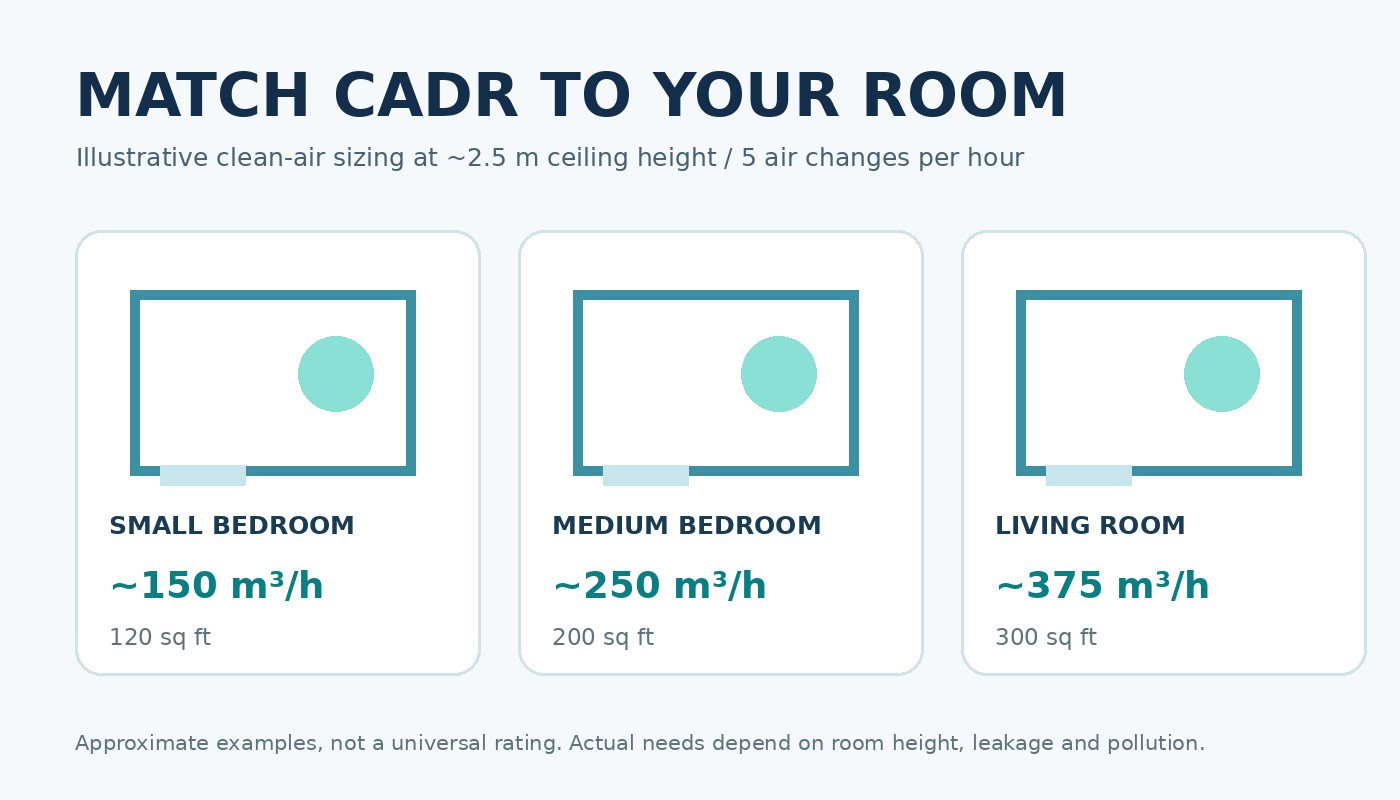
CADR stands for Clean Air Delivery Rate: the volume of filtered air the cleaner delivers per unit time. A higher particle CADR generally means faster reduction of airborne particles within a suitably sized room. India product sheets commonly express it in cubic metres per hour (m³/h); some international labels use cubic feet per minute (cfm). Do not compare the numbers without converting the units.
One useful planning calculation is: CADR (m³/h) ≈ room area (m²) × ceiling height (m) × desired equivalent clean-air changes per hour. For example, a 200 sq ft bedroom (about 18.6 m²) with a 2.5 m ceiling at five changes per hour needs approximately 232 m³/h. This is a practical estimate, not a guaranteed medical or regulatory target.
The US EPA advises choosing adequate particle CADR for your room. See EPA Guide to Air Cleaners in the Home and AHAM certified air cleaner directory.
2. Which filter should you look for?
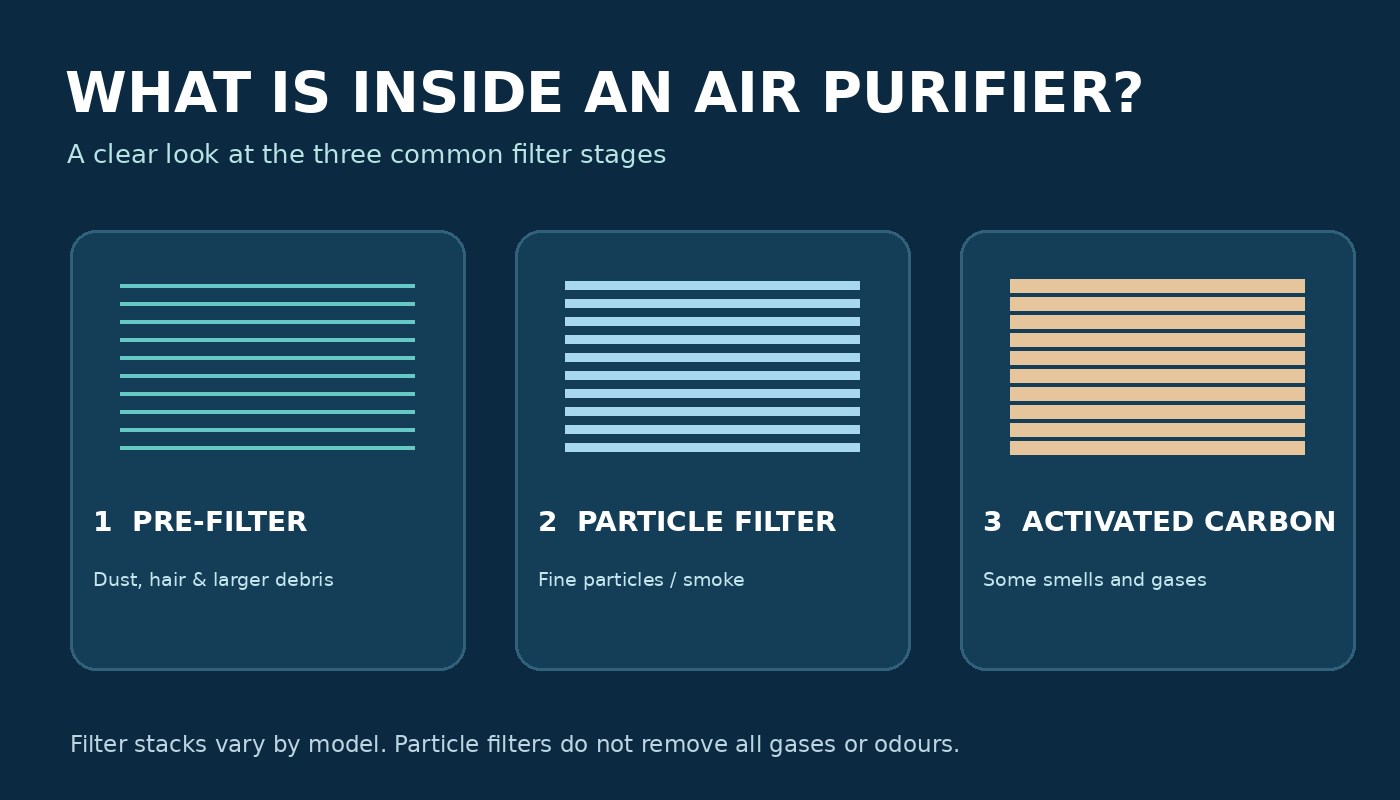
- Pre-filter: traps hair, lint and larger dust, and can help protect the main filter; some are washable, while others are not.
- HEPA or other verified high-efficiency particle filter: targets airborne particles such as fine dust and smoke. A filter label alone does not tell you the whole machine’s clean-air delivery; look at the full unit’s CADR.
- Activated carbon: can help with certain odours and gases, depending on the amount of carbon, contact time and pollutant. Thin carbon sheets have limits.
Be cautious with machines marketed primarily as ozone generators. The California Air Resources Board advises against ozone-generating air cleaners, because ozone can irritate airways. An air purifier also cannot substitute for source control, safe ventilation or cleaning.
3. Three air purifier models worth comparing in India
The models below are comparison examples, not a laboratory-tested ranking. Their CADR figures are the manufacturers’ published figures for the particular model/market and should be verified before purchase.
| Model | Published particle CADR | Why consider it? | What to confirm? |
|---|---|---|---|
| Philips 1000 Series AC1711/63 | 300 m³/h | HEPA and active carbon filtration; straightforward controls | Exact variant and compatible filter cost |
| Coway Airmega 150 (India) | 303 m³/h | Three-stage filtration, simple maintenance-focused design | Genuine filter availability, seller and warranty |
| Xiaomi Smart Air Purifier 4 Lite | 360 m³/h | Higher nominal particle CADR and connected features | Filter stock, app compatibility and local after-sales service |
Sources: Philips AC1711/63, Coway India Airmega 150 and Xiaomi 4 Lite user manual.
Important: these published figures do not guarantee the same real-world performance in every home. Room leakage, fan speed, placement and maintenance affect results. Manufacturer advertised room coverage can use different assumptions, so CADR is generally more comparable than the largest square-foot claim on a box.
4. Air purifier prices in India: what affects your budget?
Instead of treating a particular price as permanent, compare the total cost of ownership: purchase price + replacement filters + electricity. Air purifiers in different price brackets can have similar CADR yet very different filter or service costs. Indian consumer guides have recently highlighted the importance of replacement-filter availability and operating expenses. See India Today buying guidance.
Before paying: check the current listed price, genuine seller, GST invoice, warranty terms, filter-part number, official replacement cost and frequency, and return conditions. A discounted machine with unavailable replacement filters may be a costly mistake.
5. Air purifier placement and everyday use
- Put the air purifier in the room where you spend the most time—often a bedroom or work area.
- Keep its inlet and outlet unobstructed; do not tuck it tightly behind curtains or furniture.
- Use a higher fan speed when particle levels are high and a quieter speed when needed for sleep.
- Follow manufacturer instructions for cleaning the pre-filter and changing the main filter. Do not wash a non-washable HEPA filter.
- When outdoor pollution is high, limit unnecessary outdoor air entry, while still addressing necessary ventilation and indoor pollution sources.
6. Common questions before buying
Will an air purifier remove PM2.5?
An appropriately sized, high-efficiency particle-filter purifier can reduce airborne PM2.5 indoors. It cannot remove pollution sources or guarantee zero exposure.
Can one purifier clean the whole house?
A single portable purifier is usually designed for one room or connected space, not every closed bedroom in a home. Choose based on the actual room and airflow between spaces.
Is HEPA H13 always better than a purifier without that label?
Not necessarily for the finished unit. Filter efficiency and whole-machine airflow both matter. Compare tested particle CADR and actual filter availability rather than relying on one badge.
Does an air purifier replace a mask or ventilation?
No. Filtration complements other measures; it does not replace all ventilation, cleaning, source removal or appropriate personal protection.
How often should a filter be replaced?
It depends on the model, operating time and pollution levels. Follow the specific manufacturer guidance and monitor filter condition; never assume all brands have the same interval.
Final verdict: how to shop smarter
For most Indian buyers, the sensible shortlist starts with adequate CADR, genuine particle filtration, easily available replacement filters and manageable running costs. Compare two or three authentic model listings and ignore claims such as “100% pollution protection.” A good purifier can help reduce airborne particles indoors, but it is not a medical treatment or a complete solution for air pollution.
Explore more useful buying advice in our air fryer buying guide and air fryer safety explainer.
Research and transparency: Prepared 21 November 2026 using manufacturer product specifications and air-cleaner guidance from the US EPA, AHAM and California Air Resources Board. No products were physically tested by Budget Shoppy for this article. No live product prices or affiliate links are implied by this guide.