

Updated 16 November 2026 • 8-minute read • Budget Shoppy shopping safety guide
Picture this: you are scrolling through Instagram after dinner. A pair of branded headphones that normally costs a few thousand rupees is suddenly advertised for ₹999. The comments look enthusiastic. The sale ends in ten minutes. You tap “Buy now.”
That is exactly the moment to slow down. A low price can be a real bargain—but it can also be the hook for a fake store, a misleading discount, or a payment scam. You do not need to stop shopping online. You need a short routine that helps you recognise the difference.
In November 2026, the Telangana Cyber Security Bureau warned about online-shopping fraud involving fake advertisements, heavily discounted offers and malicious links. Recent reporting also highlighted scams built around festival deals and social media promotions. This guide translates those warnings into seven checks you can actually use before paying.
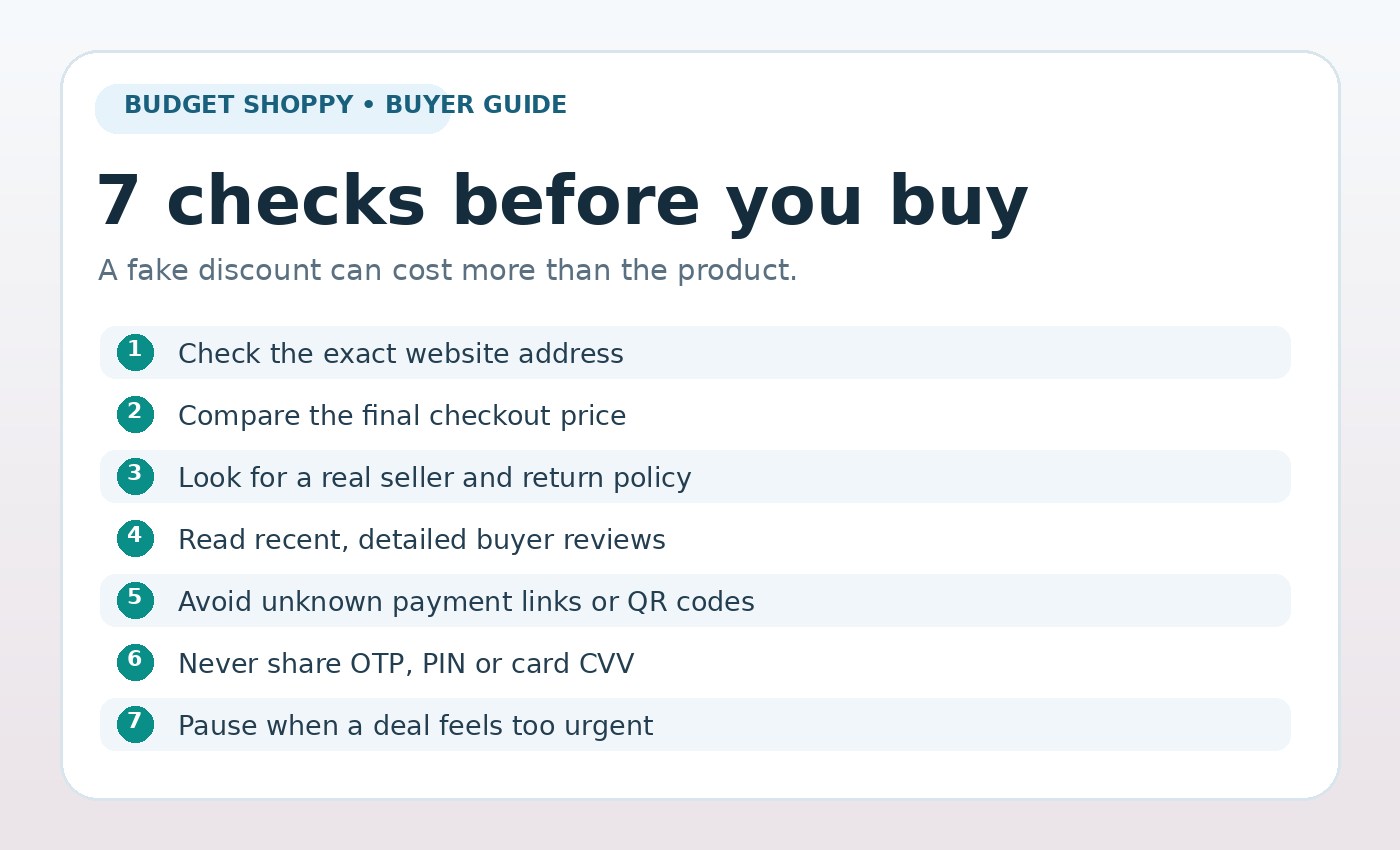
Quick answer: Check the exact website address, compare the final price, verify the seller and return rules, read meaningful reviews, avoid unusual payment requests, protect your OTP/PIN, and do not let a countdown rush you. None of these checks alone proves a site is safe; together they lower your risk.
Why fake online deals deserve attention in 2026
Online shopping is now part of everyday life, from festival gifts to kitchen tools and skincare. That makes a “limited-time deal” feel normal. The problem is that real promotions and fraudulent ones can appear in the same social feed.
Telangana’s cyber-safety warning, reported on 11 November 2026, described fraudsters circulating ads on social platforms and creating fake websites promising discounted electronics, clothes and services. Meanwhile, the Indian government has announced updated e-commerce rules addressing clearer disclosures around discounts and sponsored listings. Those amendments are scheduled to take effect on 1 January 2027; they should not be described as already in force today.
Here is the practical takeaway: do not judge a deal by its percentage-off sticker. Judge it by who is selling, what you will actually pay, and what happens if something goes wrong.
1. Read the entire website address—not just the logo
A polished page can copy colours, product photographs and even a familiar brand name. Before paying, tap the address bar and read the full domain carefully. Watch for misspellings, extra words, unexpected endings or an address that differs from the retailer’s known site.
It is safer to open a shop from your saved bookmark or type its official address than to follow a link from a forwarded WhatsApp message. HTTPS is important, but the padlock alone does not prove the business is genuine. Scam websites can use HTTPS too.
Try this: If an unfamiliar ad claims to represent a major marketplace, close the ad, visit the marketplace directly and search for the same product there.
2. Compare the final payable price, not the headline discount
Imagine two sellers advertise the same mixer grinder. Seller A shows “70% off” but adds a delivery fee and handling charge at checkout. Seller B shows a smaller discount but includes delivery. The only meaningful comparison is the total amount you must pay for the same model and warranty.
Write down three things: the model number, the all-in checkout amount, and the seller’s return terms. If the deal depends on a bank card or coupon you do not have, do not count that discount.
Another useful habit is checking price history where a trustworthy tracker covers the product. Just remember that price-tracking tools can miss sellers, variations or short promotions.
3. Find out who is actually selling the product
A product page and a seller are not always the same thing. Look for an identifiable seller or business, clear contact details, a sensible delivery estimate and a return or refund policy you can understand. Read who pays return shipping and whether electronics, personal-care items or sale merchandise are excluded.
A seller with almost no verifiable information is a reason to investigate further, especially on an unfamiliar independent site. A glossy “About” page full of generic promises is not the same as useful contact and service information.
4. Read reviews like a detective
Do not rely only on the star rating. Start with recent reviews, especially the detailed negative ones. Look for comments about the specific model, warranty, actual delivery and refund experience. Reviews with real context are more useful than a flood of one-line praise.
Repeated identical wording, sudden bursts of five-star ratings or photos that do not match the listed item should make you cautious. None of those is proof of fraud on its own, but they are good reasons to check other sources.
For a broader guide on genuine versus counterfeit products, see our fake vs original products checklist.
5. Be careful with payment links, QR codes and direct transfers
If a seller unexpectedly asks you to move the transaction from the official checkout to a personal UPI number, messaging app or unfamiliar payment link, stop and verify. Pay through a recognised checkout or payment process whenever possible.
Do not scan a QR code sent by a stranger on the promise that it will “release a refund.” Payment instructions should make sense for the transaction. When in doubt, contact customer support through the store’s independently verified website or app—not the phone number inside a suspicious message.
6. Never share your OTP, UPI PIN or card security code
A fraudster may claim your order is stuck, your delivery is delayed or a refund needs verification. The message may sound urgent and professional. Your bank OTP, UPI PIN and card CVV are sensitive secrets, not customer-service details.
If someone is requesting those details through chat, a call, or a form you reached from an unexpected link, end the interaction and contact your bank or provider using an official channel.
7. Treat countdown timers as a reason to pause
“Only two left.” “Offer ends in five minutes.” “You will lose your discount.” Some urgency messages may reflect real stock or sale windows; others are designed to pressure you. A purchase you regret will not become good value simply because you placed it quickly.
Give yourself a small waiting period on non-essential purchases. Even ten minutes can be enough to compare the model, search the seller name and read the return policy. For bigger purchases, sleep on it.
A real-world-style example: the ₹999 headphone deal
Illustrative scenario, not a verified incident: You see ₹999 headphones advertised with a claimed original price of ₹4,999. The product image is familiar, but the website has a strange address and the seller asks for direct UPI transfer.
- Search the exact product model on a known retailer’s website.
- Compare the total checkout price and warranty terms.
- Look for the independent seller’s identity and refund process.
- Read recent model-specific reviews.
- Reject any request to pay outside the site’s standard checkout.
If the offer still cannot be independently verified, skipping it is usually cheaper than risking the entire purchase amount.
What changed in India’s e-commerce rules?
On 10 September 2026, the Ministry of Consumer Affairs announced amendments to India’s e-commerce consumer-protection rules, scheduled to take effect 1 January 2027. Among other requirements, the amended rules address clear identification of sponsored listings and the display of prior prices when a seller announces a price reduction. They also address deceptive design practices, often called dark patterns.
That matters because a dramatic discount label does not tell a shopper whether the comparison price was realistic. The rules are an important development, but they do not replace your own seller and payment checks.
If you have already paid a suspicious seller, what should you do?
Act quickly. Save the product page, order confirmation, messages, payment reference and screenshots. Contact your bank or payment provider through an official channel to report the transaction and ask about available safeguards.
- Suspected online financial fraud: call India’s cyber-fraud helpline 1930 promptly and report at cybercrime.gov.in.
- Consumer complaint about a legitimate purchase: approach the merchant first; the National Consumer Helpline also accepts complaints at 1915 and through its website.
- Account compromise: change affected passwords, review transactions and turn on stronger account security.
Reporting promptly can improve the chance of a response, but it does not guarantee the recovery of lost money.
The 30-second checklist to remember
Before you tap Pay, ask yourself: Is this the right site? Is this the real final price? Do I know the seller? Can I return it? Are these reviews useful? Is the payment request normal? Am I being rushed?
Smart shopping does not mean chasing the biggest discount. It means making a purchase you understand and can afford. For more practical buying ideas, read our guide to saving money online or our Amazon vs Flipkart comparison.
Sources and further reading
- Telangana Cyber Security Bureau advisory coverage, Siasat, 11 November 2026.
- Ministry of Consumer Affairs: 2026 amendment to e-commerce rules, 10 September 2026.
- Ministry of Home Affairs: Cyber fraud reporting and 1930 helpline, 28 July 2026.
- National Consumer Helpline: official contact details.
Editorial note: This is an informational safety guide based on cited public sources and practical shopping checks. It is not a product test, a sponsored ranking or a report of first-hand fraud. The product and price in our illustration are fictional examples. Read our affiliate disclosure.